

Search Website
Characterizing the lifetime phases of wildland fires from the Sioux Lookout District in Ontario.
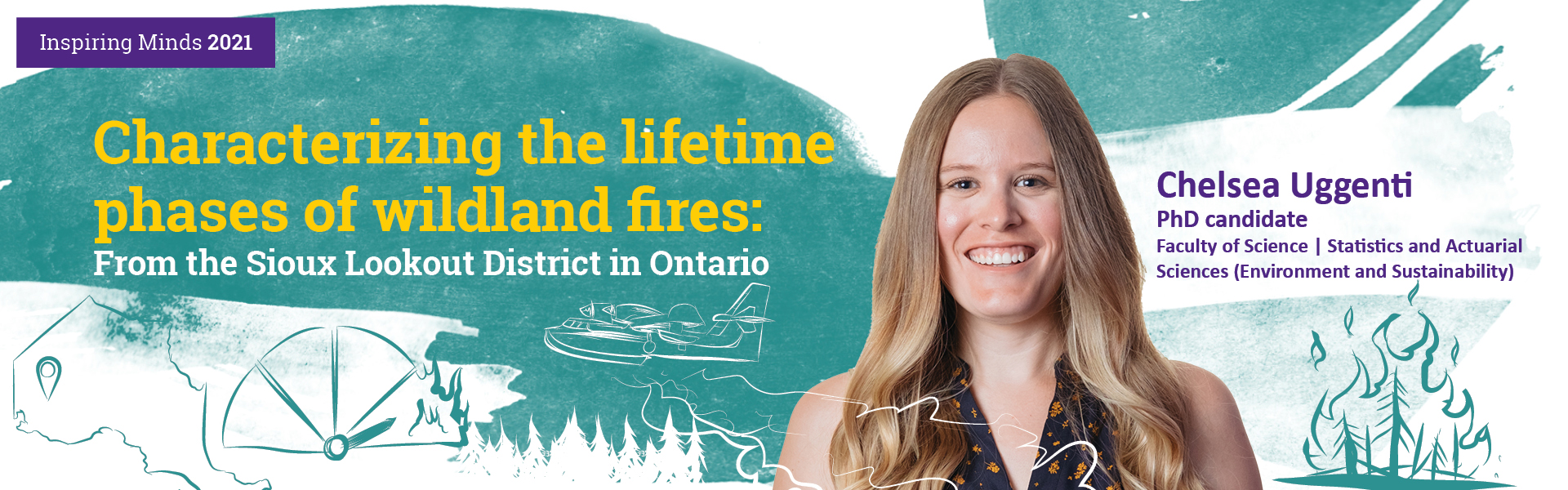
By Chelsea Uggenti
Chelsea Uggenti is using statistical models to understand how wildfires develop from ignition to containment.
By Chelsea Uggenti
PhD candidate, Statistics and Actuarial Sciences (Environment and Sustainability)
Faculty of Science - Western University
The lifetime of a fire, from its ignition to extinguishment, can be split into several key phases of interest. Past research has considered only one subcomponent of that lifetime; for example, the time it takes to attack a fire with resources to the time it’s declared under control. But this leaves a crucial gap – how does a fire progress through its many phases and how are these phases interrelated? My research investigates wildland fires located in the Ontario’s Northwest Fire Region. The progression of phases from ignition to under control are examined using statistical models that allow us to link these phases together. Various effects are accounted for, including seasonality, the type of fuel burning, and whether there are any “fire-specific” effects. Our goal is to identify and understand the factors that drive a fire’s progression through all the phases along with those that only influence certain phases.
Chelsea is a PhD candidate and statistician with interests in environmental statistics, survival analysis, and statistical education. She received her MSc in Statistics from Western University in 2017 and her BA in Mathematics from Wilfrid Laurier University in 2016. She is greatly interested in collaborating with researchers from various fields, especially those interested in education.
You can connect with Chelsea via email: cuggenti@uwo.ca
View Chelsea's work as it appears in the Inspiring Minds Digital Collection: https://ir.lib.uwo.ca/inspiringminds/163/