

Search Website
Affordances of Coding in School Mathematics and Beyond
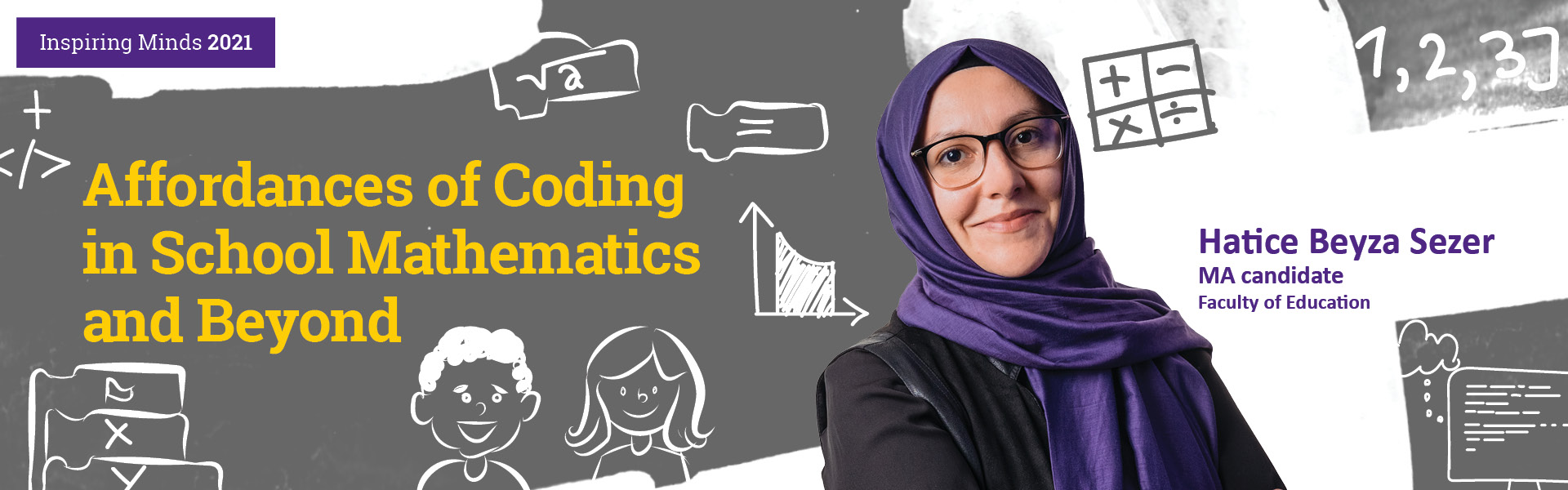
By Hatice Beyza Sezer
Do you know the creator of the world's largest coronavirus tracker? The creator is not a high-end programming company or a genius computer scientist but just a seventeen year-old teenager who started coding at the age of seven. As a mathematics teacher, I realize the opportunities that the teaching and learning coding affords not only low floor-high ceiling but also wide walls experiences. I am interested in the integration of coding in mathematics education to help students in providing solutions for real life challenges. Therefore, I designed my study to analyze current coding implications and, specifically mathematical simulations of the spread of the COVID-19 pandemic, which were created using Scratch, a block-based programming language. My analysis outcomes will be used for the learning and teaching design of coding in the elementary and middle school levels of mathematics education.
Hatice Beyza is a passionate instructor and a long-term researcher with more than 15 years of experience. She recently received her MA degree from the Faculty of Education at Western University, and she also holds an MA degree and an ABD PhD in Education from Turkey. During her MA, she participated in multiple projects and received several scholarships and awards such as Mitacs Research Training Award (RTA). Currently, she is a Research Associate at Western University and works as a part-time STEAM instructor. In addition, she is a columnist at OAME Gazette, a podcaster at OAME Talks, and an editor at Math+Code ‘Zine. Her current research is on the integration of computational thinking into mathematics education, and she specifically focuses on the critical aspect of computational thinking and its applications and implications in mathematics education.
You can connect with Hatice Beyza Sezer on LinkedIn: https://www.linkedin.com/in/hatice-beyza-sezer-155300207/ and via email: hsezer2@uwo.ca.
View Hatice's work as it appears in the Inspiring Minds Digital Collection: https://ir.lib.uwo.ca/inspiringminds/13/.