

Search Website
Folk Theories and Explainable Artificial Intelligence
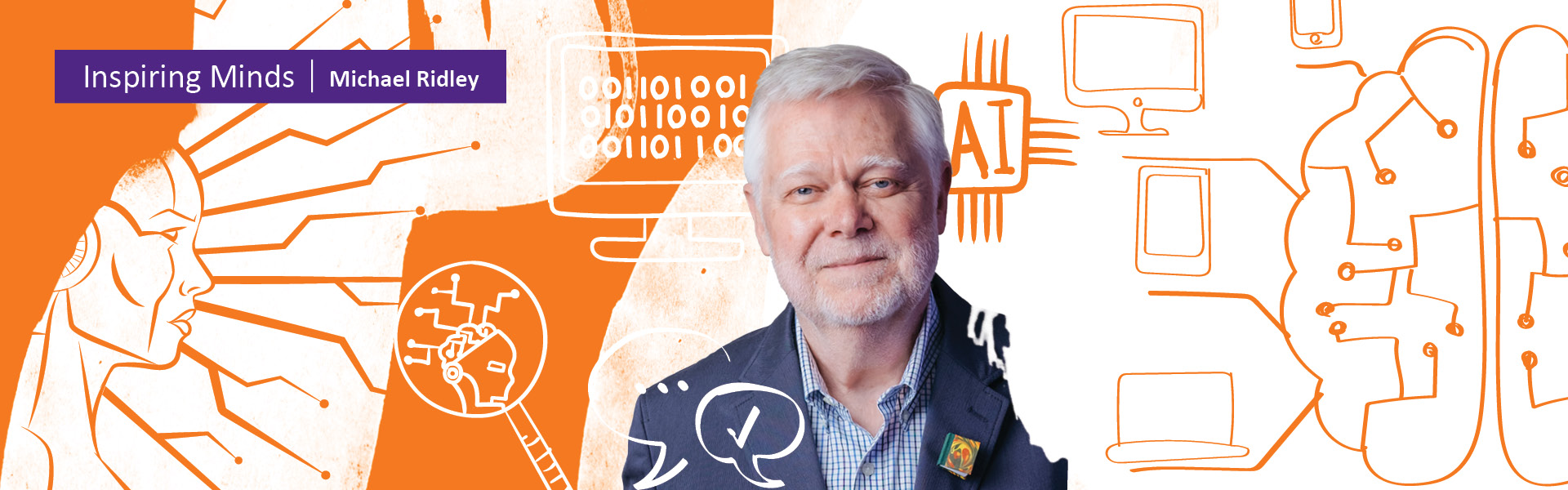
By Michael Ridley
Michael Ridley is exploring how explainable AI and human “folk theories” can improve understanding between people and machines.
By Michael Ridley
PhD candidate, Library and Information Science
Faculty of Information and Media Studies - Western University
If artificial intelligence is so smart, why can’t it explain itself? Machine learning systems, the leading-edge of AI, are powerful, complex, consequential, opaque, and not very forthcoming. Systems like Amazon, Google, and others are part of our everyday experience. We need them to explain themselves. “I can’t tell you” or “I don’t know” aren’t an acceptable answers. The field of “explainable AI” (XAI) is about getting machine learning systems to tell us what they did, why they did it, and why they didn’t do something else instead. How can we help machine learning systems make better explanations? Enter folk theories. Folk theories are the beliefs people hold about how machine learning systems work. They may be not fully accurate, but they are functional. They help people use the system. Having folk theories and XAI work together allows machines to better understand humans and humans to better understand machines. Win-win.
Michael Ridley is a PhD candidate in Library and Information Science in the Faculty of Information and Media Studies at Western University. He holds a BA from Guelph, an MLIS from Toronto, an MA from UNB, and an MEd from Toronto. After a 40-year career as an academic librarian and academic administrator, mostly at the University of Guelph, Michael started a doctoral program to explore the influence of artificial intelligence in the library field. His research work involves the area of human-centred explainable AI (HCXAI).
You can connect with Michael on his website: www.MichaelRidley.ca.
View Michael's work as it appears in the Inspiring Minds Digital Collection: https://ir.lib.uwo.ca/inspiringminds/370/