
Admissions
Equity, Diversity, Inclusion and Decolonization
The School of Graduate and Postdoctoral Studies is committed to equity, diversity, inclusion and decolonization in all aspects of graduate and postdoctoral studies. For more information regarding these commitments please visit grad.uwo.ca/edi-d.
Pathology and Laboratory Medicine
Master of Science (MSc)Meet Saumik Biswas, MSc candidate in Pathology
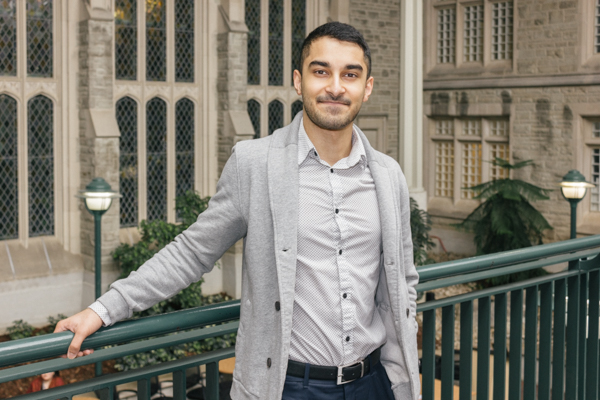
Supervisor: Subrata Chakrabarti
Why did you come to Western for your graduate degree? I decided to pursue my graduate degree at Western University for several reasons. First, the Pathology program at Western is very reputable. Second, the unique translational aspects of the program set it apart from other Pathology programs across Canada. Third, Western University is home to cutting-edge research.
Do you engage in volunteer activities?
Yes, I volunteer with “Be Al U Ca-N B”. I go to elementary school classes where I teach the children about diabetes and the research that I do. I also volunteer with “Retiring with Strong Minds”, I am able to talk about my research to senior residents living in retirement homes.
Have you worked as a TA or RA?
Being a research assistant has allowed me to develop, and expand, valuable skills such as critical thinking, creativity, persistence, and communication. These skills will compliment my future academic career.
What one thing would you like people to know about you?
No matter where you come from, anything is possible. I want people to know that I’m the first person in my family to attend university and pursue graduate work.
What’s the best advice you could give to someone considering applying to your graduate program?
First, find a topic that interests you. After that, find a supervisor that will inspire you to learn and grow as a graduate student. Then it will be up to you to take advantage of the available opportunities and make the best out of these opportunities.
Program Websites
Program Contact
Tracey Koning (pathgrad@uwo.ca)Graduate Program Coordinator
Department of Pathology and Laboratory Medicine
Western UniversityDental Sciences Rm 4044
London, Ontario N6A 5C1
Graduate research is focused on the mechanisms of cell and tissue injury; the etiology, pathogenesis and behaviour of disease; identification of novel biomarkers; potential treatment targets of various diseases; and molecular imaging.
Program Length
- 6 Terms (Full-time study)
- 12 Terms (Part-time study)
Program Design
- Full-time study or part-time study
- Thesis-based
Funding Information
Applicants are encouraged to apply for the following scholarships (if eligible):
Tuition and Fees
Tuition and fee schedules (per term) are posted on the Office of the Registrar's website at http://www.registrar.uwo.ca/student_finances/fees_refunds/fee_schedules.html
Use this helpful tool, although designed to reflect costs associated with in person programs, to estimate how much money you will need to pay for your tuition, fees, and other expenses for a 12-month (three term) academic year.
Admission Requirements
- Honours degree (4 year degree) in the Sciences; M.D or D.D.S. degree from a recognized university or college.
- A third and fourth year combined entrance average of 80% or greater.
English Language Proficiency
Applicants whose first language is not English must furnish evidence of their proficiency in the use of the English language by a satisfactory achievement within the last two years in one of the following:
- The Test of English as a Foreign Language (TOEFL). The minimum acceptable score is 5 both individual and overall. Prior to 21 January 2026, minimum score of 100, with no individual score below 25. [Western's TOEFL ID is 0984].
- The International English Language Testing Service (IELTS Academic). The minimum acceptable score is 7 out of 9. The IELTS is offered in 6 test centres in the US and 3 in Canada.
- The Duolingo English Test. The minimum acceptable score is 120.
- The Canadian Academic English Language Assessment (CAEL Assessment). The minimum acceptable score is 60. The CAEL Assessment is offered in several countries throughout the world as well as Canada.
- Western English Language Centre. The requirement is successful completion of the High-Advanced level.
- Fanshawe College’s ESL Program. The requirement is graduation from Level 10, English for Academic Purposes, with a minimum 80% in all components.
- February 1 - Fall Term
- June 1 (pending spots remaining) - Fall Term
- March 1 - Summer Term
- November 1 - Winter Term
- Molecular Pathology and Transplant Pathology
- Neuropathology
- Oncology & Environmental Pathology
- One Health
Students who are required to present evidence of proficiency in English must make their own arrangements to write the TOEFL, IELTS, or CAEL and to have the official results sent directly to the School of Graduate and Postdoctoral Studies by the testing agency. Those graduates from Fanshawe College’s ESL Program must provide official proof of graduation.
Application Deadline
Applications are accepted year round however, you should try to meet the deadlines above in order to be accepted for the term you are applying to.
Fields of Research


