
Admissions
Equity, Diversity, Inclusion and Decolonization
The School of Graduate and Postdoctoral Studies is committed to equity, diversity, inclusion and decolonization in all aspects of graduate and postdoctoral studies. For more information regarding these commitments please visit grad.uwo.ca/edi-d.
Pathology and Laboratory Medicine
Graduate Diploma (GDip)Meet Victor Dutrizac, GDip Candidate in Pathology and Laboratory Medicine
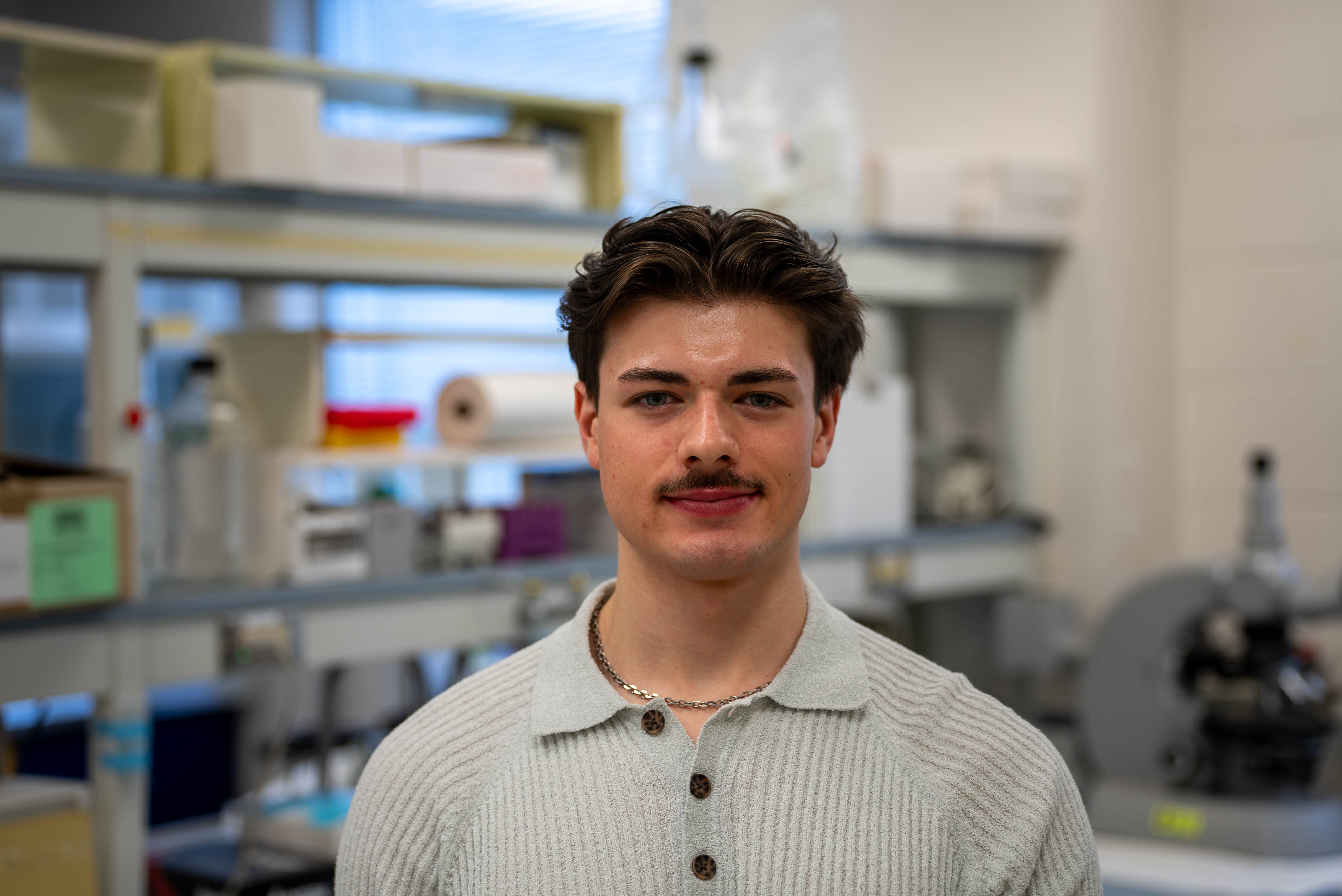
Describe your research.
My research focuses on renal cell carcinoma (RCC), the deadliest form of kidney cancer, which often spreads to the lungs. I am studying a protein called kidney injury molecule-1 (KIM-1), which seems to protect against metastasis when it stays on the tumour cell surface, but is linked to worse outcomes when it is shed into the blood. Using kidney cancer cells I am creating a version of KIM-1 that cannot be shed and testing how this affects lung metastases in mouse models. This work may clarify how KIM-1 controls RCC spread and identify new ways to limit metastasis.
What is it about your grad program that enables you to thrive and be successful?
Having a supervisor like Dr. Gunaratnam, who trusts my ability to do research and supports me at every step, has been a huge part of my success in this program. I’m also surrounded by supportive staff and graduate students who are generous with their time, whether it’s teaching me new lab techniques or helping troubleshoot experiments when things don’t go as planned. Beyond the lab, the structure of the program really helps me thrive: we have a graduate courses where I get to hear other students present their research, which broadens my perspective and gives me new ideas, and there are formal research checkpoints at the end of each term that keep me accountable, reflect on my progress, and set clear goals for the next stage of my project.
Program Websites
Program Contact
Tracey Koning (pathgrad@uwo.ca)Graduate Program Coordinator
Department of Pathology and Laboratory Medicine
Western UniversityDental Sciences Rm 4044
London, Ontario N6A 5C1
The aim of the Graduate Diploma program is to bridge undergraduate and advanced graduate training, develop and expand student’s research skills, and facilitate developing tomorrow’s scientists who will make significant contributions to the advancement towards the understanding of disease.
Students in the Graduate Diploma program will carry out mentored, intensive basic science research in the laboratory of a graduate faculty member. In addition to developing and expanding research skills, students will enroll in courses specifically designed to introduce them to research terminology, theoretical research underpinnings, modern experimental models of human disease, and critical appraisal of scientific literature.
Program Length
- 3 Terms
Program Design
- Full-time study
- Project-based
Tuition and Fees
Tuition and fee schedules (per term) are posted on the Office of the Registrar's website at http://www.registrar.uwo.ca/student_finances/fees_refunds/fee_schedules.html
Use this helpful tool, although designed to reflect costs associated with in person programs, to estimate how much money you will need to pay for your tuition, fees, and other expenses for a 12-month (three term) academic year.
Admission Requirements
Degree Requirements: Applicants must have obtained a 4-year undergraduate degree (science background preferred) from an accredited University. A minimum academic average of 80% during the final two years of the undergraduate program is required. Students with a lower average may also be considered by the selection committee on an individual basis. Applicants with an MSc degree in one of the named disciplines will also be considered, as well applicants with MD, DDS or MBBS degrees.
Meeting the minimum requirement does not guarantee acceptance to the program.
Additional Requirements
Students in the Graduate Diploma program will be required to connect with a potential supervisor prior to applying. Once a supervisor has been identified and is agreeable, the application process may be initiated.
English Language Proficiency
The Department of Pathology and Laboratory Medicine does not offer conditional admission based on completion of an English language proficiency program. Students who are required to present evidence of proficiency in English must make their own arrangements to write the TOEFL, IELTS or CAEL and to have the official results sent directly to the School of Graduate and Postdoctoral Studies by the testing agency. Those graduates from Fanshawe College’s ESL Program must provide official proof of graduation.
- The Test of English as a Foreign Language (TOEFL). The minimum acceptable score is 5 both individual and overall. Prior to 21 January 2026, minimum score of 100, with no individual score below 25. [Western's TOEFL ID is 0984].
- The International English Language Testing Service (IELTS Academic). The minimum acceptable score is 7 out of 9 with no individual module less than 6. The IELTS is offered in 6 test centres in the US and 3 in Canada. The online IELTS Indicator test is not accepted. we are accepting the new IELTS Online test as it contains all of the components of the test conducted at a testing center.
- The Duolingo English Test. Applicants must attain a minimum score of 120.
- The Canadian Academic English Language Assessment (CAEL Assessment). The minimum acceptable score is 60. The CAEL Assessment is offered in several countries throughout the world as well as Canada.
- Western English Language Centre. The requirement is successful completion of the High-Advanced level.
- Fanshawe College’s ESL Program. The requirement is graduation from Level 10, English for Academic Purposes, with a minimum 80% in all components.
- February 1 - Fall Term (first round of offers deadline)
- June 1 - Fall Term (second round of offers deadline)
- March 1 - Summer Term
- November 1 - Winter Term
Students who are required to present evidence of proficiency in English must make their own arrangements to write the TOEFL, IELTS, or CAEL and to have the official results sent directly to the School of Graduate and Postdoctoral Studies by the testing agency. Those graduates from Fanshawe College’s ESL Program must provide official proof of graduation.


