
Admissions
Equity, Diversity, Inclusion and Decolonization
The School of Graduate and Postdoctoral Studies is committed to equity, diversity, inclusion and decolonization in all aspects of graduate and postdoctoral studies. For more information regarding these commitments please visit grad.uwo.ca/edi-d.
English
Doctor of Philosophy (PhD)Meet Maya Jaishankar, PhD candidate in English
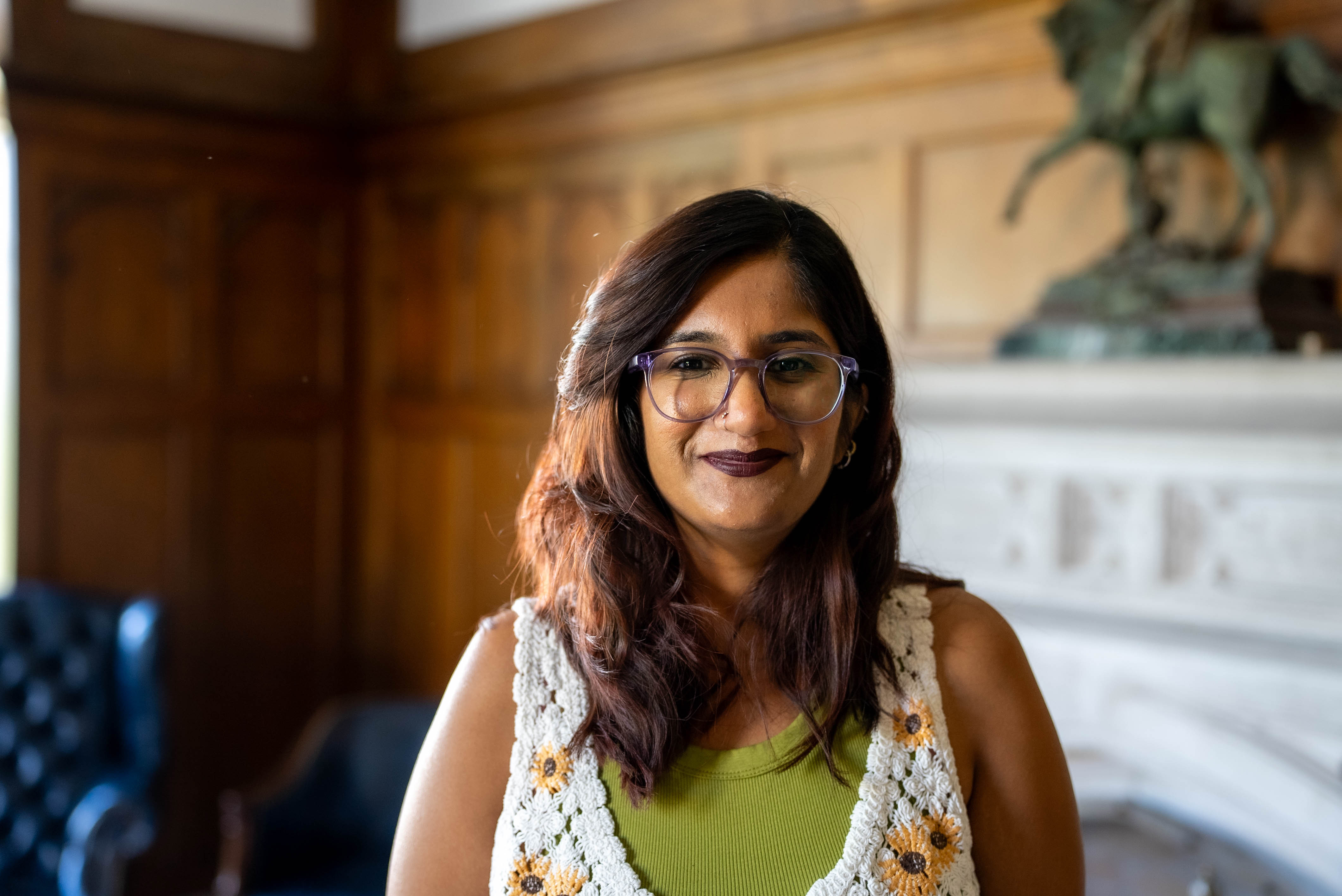
Describe your research.
I am doing a comparative study of Indian authors, and I'm specifically looking at the short story genre. The short story genre within post-colonial studies is quite an under-researched portion, and there isn't a lot of scholarship on it. I'm hoping to expand scholarship within the area by approaching it through more of a spatial lens and use that as a means of thinking about subjectivity and expression of cultural identity.
What is it about your grad program that enables you to thrive and be successful?
I would say that finding a community within the department is definitely something that helps, because for me personally, I found colleagues that I was very comfortable working with, and they're also colleagues that have that have turned into friends. It's wonderful to have a kind of body doubling through the entire process and knowing that you're not quite alone in doing what you're doing.
What's the best piece of advice you would give to someone considering this program?
Find like minded people, but maybe try and talk to people who are in fields that are slightly different than yours as well, so that you can figure out whether the place has, the resources to support the kind of research that you want to do.
Program Websites
Program Contact
Leanne Trask (genglish@uwo.ca)Graduate Affairs Assistant
Department of English
Western UniversityUniversity College 2401
London, Ontario N6A 3K7
t. 519-661-2111 ext. 85793
f. 519-661-3776
The Department's graduate program ranks as one of the strongest and most diversified graduate programs in Canada. Its central attraction is the Department's distinguished faculty and its considerable accomplishments in all areas of criticism and scholarship. The faculty's range of expertise provides the advantages of traditional scholarship and an array of historical approaches to the major literary periods and genres, as well as diverse theoretical and interdisciplinary perspectives that include discourse analysis, cultural studies, postcolonial literature and theory, feminist and gender studies, gay studies and theories of masculinity, ecological criticism, film, hypertext, theories of race, and the intersection between literature and the discourses of science, medicine, music, art, and law.

The Own Your Future doctoral professional development program will help you become a career-ready graduate with the skills necessary to excel in your studies and achieve your future goals. By participating in the program, you will assess your own strengths and opportunities for growth, choose what skills you want to enhance during your time at Western, and learn how to articulate the skills you gained in your degree to optimize your future career opportunities. To learn more, visit www.uwo.ca/ownyourfuture.
Program Length
- 12 Terms
Program Design
- Full-time study
- Thesis-based
Funding Information
Applicants are encouraged to apply for the following scholarships (if eligible):
Tuition and Fees
Tuition and fee schedules (per term) are posted on the Office of the Registrar's website at http://www.registrar.uwo.ca/student_finances/fees_refunds/fee_schedules.html
Use this helpful tool, although designed to reflect costs associated with in person programs, to estimate how much money you will need to pay for your tuition, fees, and other expenses for a 12-month (three term) academic year.
Admission Requirements
- Strong first-class MA degree or its equivalent in English Literature or related field.
English Language Proficiency
Applicants whose first language is not English must furnish evidence of their proficiency in the use of the English language:
- The Test of English as a Foreign Language (TOEFL). Minimum acceptable score is 267 for the standard electronic version, 630 for the paper and pencil version, or 109 for the internet version. [Western's TOEFL ID is 0984].
- The International English Language Testing Service (IELTS Academic). Minimum acceptable score is 8 out of 9.
Application Deadline
- January 15
Fields of Research
- American Literature
- Canadian Literature
- Cultural Studies
- Indigenous Literature and Literary Criticism/Theory
- Literary Criticism and Theory
- Nineteenth-Century British Literature
- Old and Middle English Language and Literature
- Postcolonial Literature
- Renaissance (Includes separate Qualifying examinations in English Drama to the Restoration and Renaissance Non-Dramatic Literature)
- Restoration and Eighteenth-Century Literature
- Textual Studies
- Twentieth-Century British and Irish Literature
- Women’s Literature and Gender Studies Fields of Research


